“The problem is bigger than BIG”: Architecture and labor rights clash in London

A Punch List correspondent is on the scene. Plus: the architects in the Epstein files, and the Independence Arch goes XXL


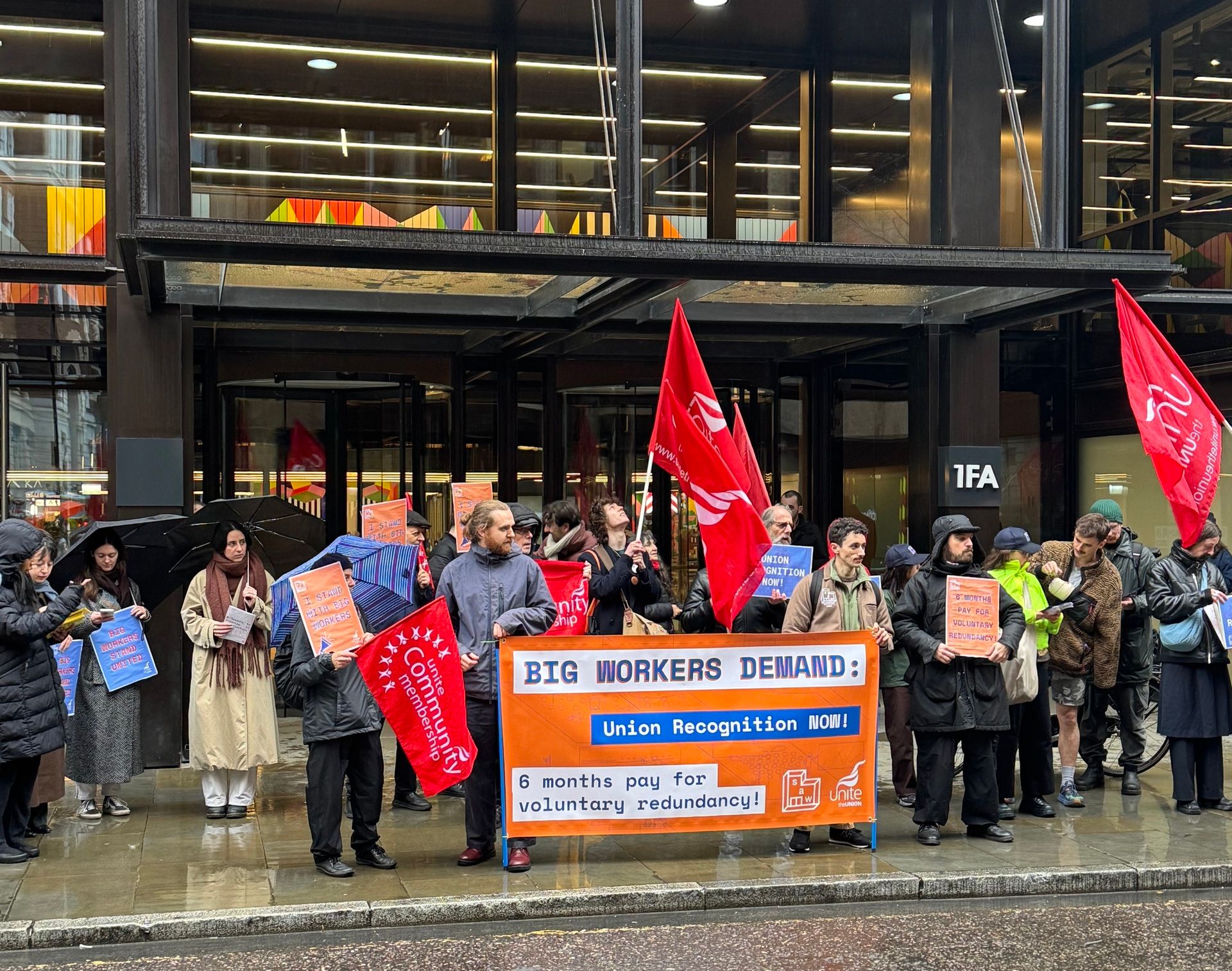
A labor protest outside the London offices of Bjarke Ingels Group, or BIG. Photo by Lev Bratishenko

Lev Bratishenko shared the following report from London:

The protesters’ demands, chanted as an icy drizzle fell on Tuesday afternoon, were laughably modest: “What do we want? Meaningful consultation! When do we want it? Now!” But there was real tension in the air, and anxiety on the faces of fifty-odd young workers standing in front of the Broadgate offices of Bjarke Ingels Group. Labor disputes rely on lawyerly phrases and abstractions like “terminated project,” “risk management,” and “challenging period for the industry.” But this crowd had gathered because people are scared and angry.

The basic facts of the story have been widely reported; an emailed statement from BIG’s communications department, while conciliatory in tone, didn’t dispute them. (The statement is included in full below.) The London office won The Project in late 2023 or early 2024. This internal euphemism is scrupulously observed because of NDA restrictions, but it has been already named elsewhere as a Red Sea resort in Saudi Arabia. The office rapidly grew to support The Project until half of all London staff were employed on it. Then, in late November 2025, the client pulled the plug, perhaps part of a larger recent Saudi retrenchment.

After BIG had notified some employees that they were at risk, these communications suddenly stopped, workers say. They resumed only in January, two anxious months later, by which time workers were getting legal advice and had started organizing through Section of Architectural Workers (SAW), the branch of Unite the Union for architectural workers and architects. An official notification that your job is “at risk” is followed by a selection process that should include things like “scoring” to pseudo-objectively justify why you are being let go. Workers told me they haven’t received this yet, and they have many unanswered questions: How management allowed this to happen in the first place and what is the math behind the large number of layoffs (estimated at 72 now, with 142 positions “at risk” out of a total headcount of 203, according to staff)? And now that over half the office has signed up to the union, why won’t the firm recognize it?

After decades of austerity and falling real wages, architectural workers around the world are waking up and looking for ways to reintegrate into broader labor movements. So the kindling is ample and dry, and the cruel particulars of this case are the spark. Individual workers are frightened about making public their stories, afraid of legal consequences or being singled out, but here’s one that was shared with me after the protest. Names and details were changed on the employee’s request.

Grace is from Asia and was already working as an architect in the UK on a skilled worker visa. She’d always wanted to work at BIG, so when the London office went on its hiring spree, she applied for and got a job. BIG did the paperwork to transfer her visa sponsorship to them and she gave notice at her old firm. A few weeks later, BIG rescinded the employment offer and informed the government, as they are required to do, meaning she had 60 days to leave the country or find another sponsored job. Grace told me messages to the London office’s head of HR bounced back with a vacation auto-response. She added that she’s proposed compromises and solutions, but according to her the firm has refused them all. She’s going home.

Several workers told me they believe 70 percent of the potential layoffs will affect people in the UK on one visa or another. And everyone I spoke to at the protest was more upset about what is happening to their friends and colleagues than about their own situation. “People have had their lives destroyed. One guy arrived the same day the project closed," said a worker who asked not to be named. Some architects quit jobs and moved entire families to London only to find themselves imminently unemployed and, according to the union, locked out of any meaningful dialogue.

The London office paid out £7,345,770 in dividends for 2024, the latest year its Companies House filings are available. The filings show that annual profits have bounced between £3 million and £10 million since 2022. Despite the current liquidity problems, Associates and Partners in London are not facing salary cuts, workers told me, and the firm is still hiring in other offices. Amidst a world-historical Noticing of Things, it’s no surprise that people are angry. Or that the problem is bigger than BIG. A SAW representative ended his speech by saying, “I want to put the rest of the industry on warning.” 

As the lunchtime business crowd nudged past, a tall woman in a long brown coat stood among the protestors, shooting some video before disappearing. It was BIG CEO Sheela Maini Søgaard, a former McKinsey consultant credited with saving the firm from dire financial pressures in 2007. Reflecting on her impact on the business in 2017, Ingels noted that “she has a ‘fuck you, pay me’ attitude. We needed that.” 

Why is it shocking when architectural firms reveal their icy corporate cores? Maybe it punctures a tender myth, when really architects are overdue, as Peggy Deamer recently wrote, for a confrontation “about what it means for architecture to be a ‘profession’ since its supposed prestige gives us such little reward or power.” Architects aren’t used to thinking of themselves as ordinary workers, replaceable and dismissible. But recognizing this truth is empowering: It puts architects back into the wider labor movement, surrounded by new friends.

Amalie Fruergaard Lund, Communications Specialist for BIG, sent the following statement by email:

“I’m afraid we don’t have much more to add than what we’ve already stated. I can verify that a major project in our London studio was terminated end of November last year due to circumstances beyond our control. The project employed roughly half the London office, and we immediately informed our entire team of the project termination. 
 
Since November, and now more than two months later, all employees have remained in employment and continue to be paid in full while we work through a formal and lawful consultation process. Most recently, a local union group representing some of the employees has made several demands, incl. additional 6 months of pay that we are unfortunately not in a position to meet. Same union group arranged an hour-long demonstration outside BIG’s offices today. Our leadership team is committed to the continuous dialogue with those affected in a thoughtful and constructive manner, in full accordance with UK guidelines and due process. 
 
Unexpected project changes are an inherent challenge in professional service firms, even with the most robust risk management and contractual processes. BIG has acted in good faith throughout and with the intention of minimizing job losses wherever possible alongside efforts to strengthen our pipeline. We deny claims that we have sought to intimidate employees or undermine lawful union activity. Our focus remains on treating all staff with respect, transparency, and fairness during a challenging period for both the studio and the wider industry.”

Lev Bratishenko is Twister of Meaning at The Cosmic House and a recovering curator.

News & Notes

A New Coke moment for Philly’s leading art museum.

Architects and designers appearing in the Epstein files, mostly via emails to or from Tom Pritzker, include Renzo Piano, Richard Meier, Neri Oxman, and the late Frank Gehry.

Three terrible options to choose from! Trump posted new renderings of the Independence Arch, assessed in Punch List last month, on Truth Social. Each version would measure 250 feet high, or two-and-a-half times as tall as the Lincoln Memorial. The designs get more gilded as they go. Of course they do.

Alissa Walker summarizes a new report on L.A.’s options if it wants to ditch the 2028 Olympics, a.k.a. the only Summer Games destined to be remembered for ICE.

A call to save the Urban Design Division of New York City’s planning department.

Zach Mortice and Michael Kimmelman review the Bruce Goff show at the Art Institute of Chicago. I love Zach’s piece but I’ll be damned if Ada Louise Huxtable ever typed the phrase “a phenomena”!

Punch List is published weekly. Subscribe free here, or sign up for a paid subscription, with bonus material, here.

Reply

or to participate.