- Punch List Architecture Newsletter
- Posts
- American architecture at 250: a reading list
American architecture at 250: a reading list
Some resources for the semiquincentennial

Christopher Hawthorne
January 02, 2026
Fifty years ago yesterday, on New Year’s Day, 1976, the polymath designers Charles and Ray Eames (along with their colleagues Bill Tondreau and Alex Funke) released a small-scale photo book called “Images of Early America.” The publication, featuring pictures of a Quaker meeting house and other examples of modest, broad-shouldered, and clean-lined religious and vernacular architecture, accompanied an exhibition installed in the Eames-designed Herman Miller showroom, in West Hollywood.
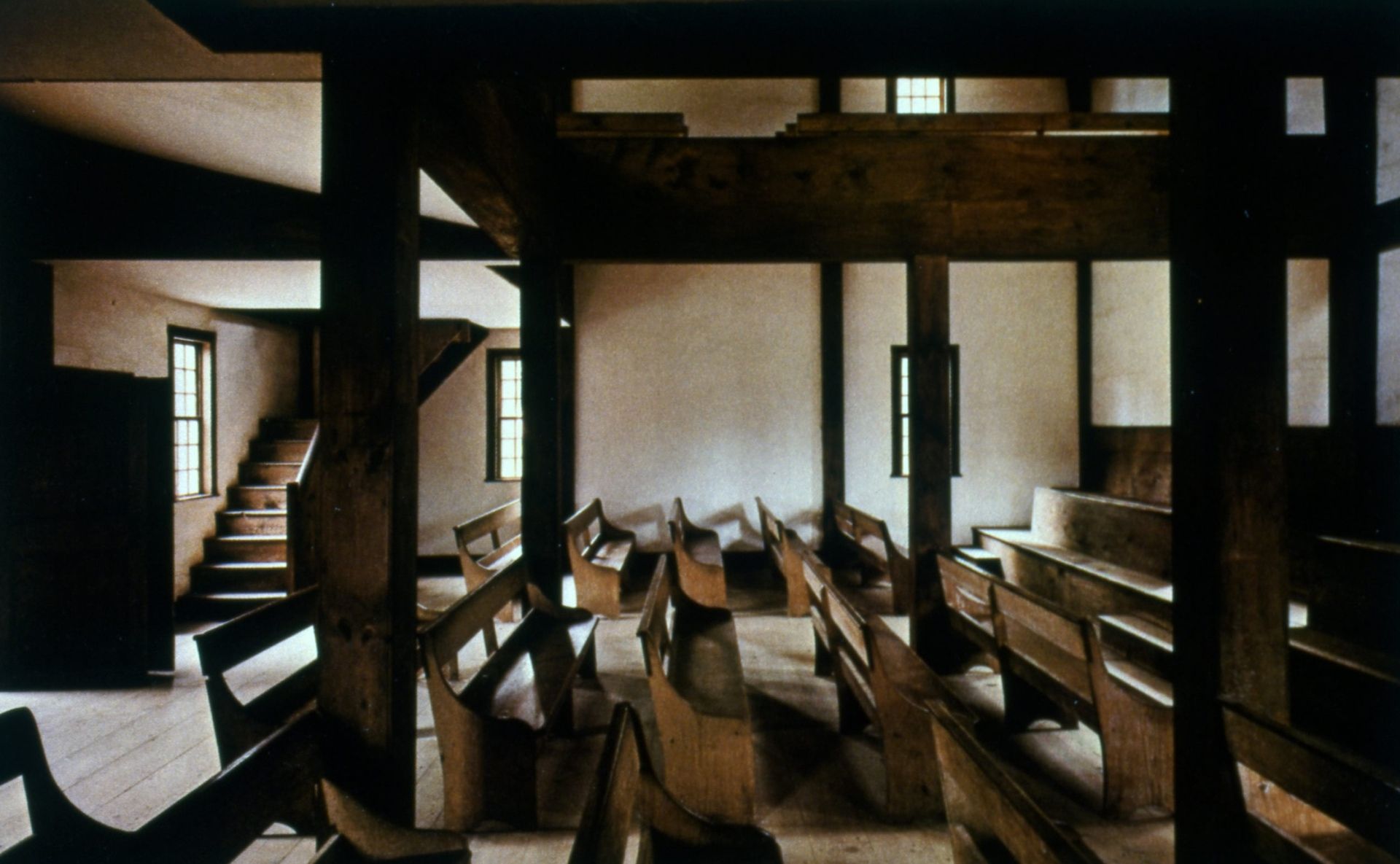
A detail from the Eames Office book “Images of Early America.” © Eames Office
The book and the show, as you will have guessed, were timed to mark the bicentennial of the United States (as a companion to the Eames Office’s better known and far more substantial “The World of Franklin and Jefferson” exhibition). They opened at a moment of extreme tumult and uncertainty in American history. Gerald Ford had pardoned his disgraced predecessor in the White House, Richard Nixon, eighteen months earlier. Ford himself had survived a pair of assassination attempts—both in California, and both at the hands of women, first Squeaky Fromme and then Sara Jane Moore—in September of 1975. The Vietnam War had ended in chaos with the Fall of Saigon just five months before that. Inflation and unemployment were both running, as 1976 began, at around nine percent.
Fast forward five decades, and the U.S. is now approaching its semiquincentennial—or hitting the quarter-millennium mark, if you prefer—in a similar state of anxiety, with a president who has not only survived his own pair of assassination attempts but is busy taking a wrecking ball to the White House grounds. (Oh, and planning a 250th celebration, on those grounds, featuring, naturally, the stars of the Ultimate Fighting Championship.) We’ll happily leave it to others to diagnose the condition of the larger body politic. Our job here, over the coming year, will be to offer some assessments of the state of American architecture, an effort that will find Punch List bringing on, for the first time, additional writers and photographers.
As a precursor to those essays and images, today we offer a reading list on American architecture. This is of course an incomplete and subjective effort, with some thoughts on standalone essays, as opposed to this list of books, to follow in the coming weeks. I welcome—encourage! beseech!—your suggestions (for both books and essays) at [email protected].
I hope at the very least this post will prompt you to start organizing your own thoughts about where the field finds itself as we approach the 250th. What follows is sorted into a handful of categories:
Overviews & anthologies:
Anderson, Sean, and Mabel O. Wilson, eds. Reconstructions: Architecture and Blackness in America. The Museum of Modern Art, 2021
Eggener, Keith, ed. American Architectural History: A Contemporary Reader. Routledge, 2004
Gelernter, Mark. A History of American Architecture: Buildings in Their Technological and Cultural Context. Manchester University Press, 1999
Huxtable, Ada Louise. The Unreal America: Architecture and Illusion. The New Press, 1997
Mumford, Lewis. Sticks and Stones: A Study of American Architecture and Civilization. W.W. Norton, 1924
Nabokov, Peter, and Robert Easton. Native American Architecture. Oxford University Press, 1989
Roth, Leland, and Amanda C. Roth-Clark. American Architecture: A History. 2nd ed. Routledge, 2016
Scully, Vincent. American Architecture and Urbanism. Frederick A. Praeger, 1969; reprinted by Trinity University Press, 2013
Upton, Dell. Architecture in the United States. Oxford University Press, 1998
Wright, Gwendolyn. USA: Modern Architectures in History. Reaktion Books, 2008
Early America:
DeWitt, Lloyd, and Corey Piper, eds. Thomas Jefferson, Architect: Palladian Models, Democratic Principles, and the Conflict of Ideals. Yale University Press, 2019
Eames Office. The World of Franklin and Jefferson. Museum of Modern Art, 1976
Eberlein, Harold Donaldson. The Architecture of Colonial America. Little, Brown and Company, 1915
Jefferson, Thomas. Notes on the State of Virginia. Annotated edition, Robert Pierce Forbes, ed. Yale University Press, 2022
Upton, Dell. Another City: Urban Life and Urban Spaces of the New American Republic. Yale University Press, 2008
Urbanism, landscape, & planning:
Banham, Reyner. Scenes in America Deserta. Gibbs M. Smith, 1982
Baudrillard, Jean. America. Translated by Chris Turner. Verso, 1998
Blake, Peter. God’s Own Junkyard: The Planned Deterioration of America’s Landscape. Holt, Rinehart and Winston, 1964. “It is not written in anger. It is written in fury.”
Jacobs, Jane. The Death and Life of Great American Cities. Random House, 1961
Sorkin, Michael, ed. Variations on a Theme Park: The New American City and the End of Public Space. Hill & Wang, 1992
Venturi and Rauch & Stephen Shore. Signs of Life: Symbols in the American City. Aperture, 1976
Houses and housing:
Hayden, Dolores. The Grand Domestic Revolution: A History of Feminist Designs for American Homes, Neighborhoods, and Cities. MIT Press, 1981
Krumwiede, Keith. Atlas of Another America: An Architectural Fiction. Park Books, 2017. Keith walked so McMansion Hell could run
McAlester, Virginia Savage, and A. Lee McAlester. A Field Guide to American Houses: The Definitive Guide to Identifying and Understanding America's Domestic Architecture. Alfred A. Knopf, updated 2013
Smith, Elizabeth A. T., ed. Blueprints for Modern Living: History and Legacy of the Case Study Houses. MIT Press, 1989
Woodbridge, Sally B., ed. Bay Area Houses. 2nd ed. Gibbs Smith, 1988
Specific cities & regions:
Banham, Reyner. Los Angeles: The Architecture of Four Ecologies. University of California Press, 1971
Cronon, William. Nature’s Metropolis: Chicago and the Great West. W.W. Norton & Company, 1991
Koolhaas, Rem. Delirious New York: A Retroactive Manifesto for Manhattan. Oxford University Press, 1978
Lewis, Peirce F. New Orleans: The Making of an Urban Landscape. University Press of Virginia, 1976
McCoy, Esther. Five California Architects. Reinhold Publishing Corp., 1960
Stern, Robert A.M., David Fishman, and Jacob Tilove. New York 2020: Architecture and Urbanism at the Beginning of a New Century. Monacelli Press, 2025
Vinegar, Aron. I Am a Monument: On Learning from Las Vegas. MIT Press, 2008
Building types:
Chase, John. Glitter Stucco & Dumpster Diving: Reflections on Building Production in the Vernacular City. Verso, 2000. Especially for the essay “The Stucco Box,” on the L.A. dingbat, written with John Beach
Lange, Alexandra. Meet Me by the Fountain: An Inside History of the Mall. Bloomsbury Publishing, 2022
Willis, Carol. Form Follows Finance: Skyscrapers and Skylines in New York and Chicago. Princeton Architectural Press, 1995
Biographies & monographs:
Baker, Paul R. Stanny: The Gilded Life of Stanford White. The Free Press, 1989
Bergdoll, Barry, and Jennifer Gray, editors. Frank Lloyd Wright: Unpacking the Archive. The Museum of Modern Art, 2017
Boutelle, Sara Holmes. Julia Morgan, Architect. Abbeville Press, 1988
Goldberger, Paul. Building Art: The Life and Work of Frank Gehry. Alfred A. Knopf, 2015
Lamster, Mark. The Man in the Glass House: Philip Johnson, Architect of the Modern Century. Little, Brown & Company, 2018
Lewis, Michael J. Frank Furness: Architecture and the Violent Mind. W. W. Norton, 2001
McCoy, Esther. Craig Ellwood: Architecture. Walker & Company, 1968; reprint, Hennessey & Ingalls, 1997
Happy New Year!
Punch List is published weekly. Subscribe free here, or sign up for a paid subscription, with bonus material, here.
Email: [email protected]
Reply