- Punch List Architecture Newsletter
- Posts
- Year in review, part two: Los Angeles the bellwether
Year in review, part two: Los Angeles the bellwether
As we near the first anniversary of the massive Eaton and Palisades fires, it’s become clear that L.A.’s future is your future too; “any place can burn down”

Christopher Hawthorne
December 26, 2025
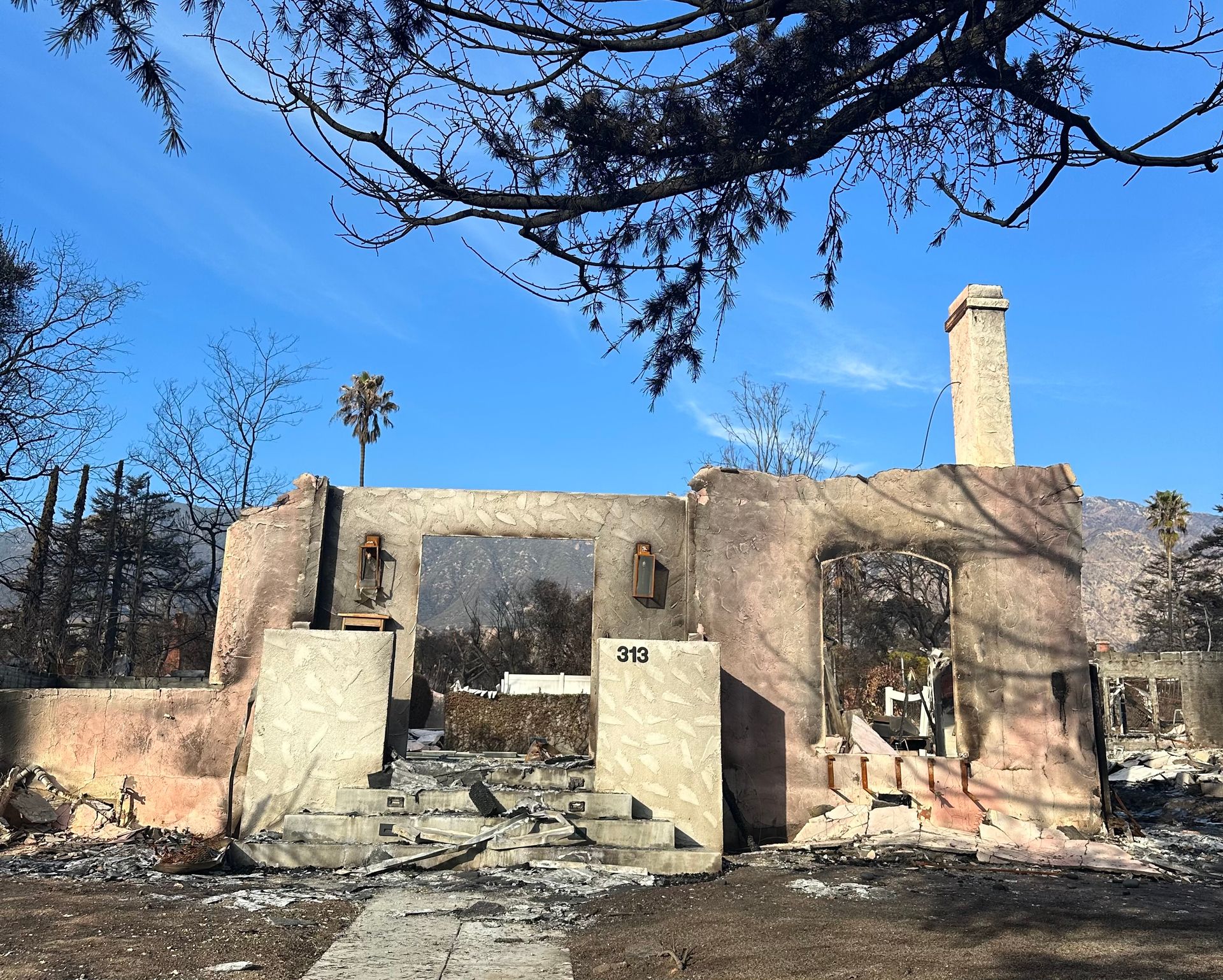
Altadena in February 2025
It was starting to get dark as Jonathan Veitch and I drove toward Altadena. This was about a month after the Eaton fire, which spared his family’s handsome 1913 Craftsman while destroying nearly two dozen houses on his block alone.
Through the windshield, as we moved into the foothills, intact strip malls and drive-throughs gave way to the tangled, sagging remains of a tiny café I remembered fondly from the many years I lived nearby. Soon the denuded San Gabriel Mountains, 10,000 feet tall at their highest point, heaved into view.
“When I used to look up at the San Gabriels, it was mostly just in awe of their beauty,” said Veitch, an L.A. native and professor of history at Occidental College, where he served as president from 2009 to 2020. “Now all I see is a tinderbox.”
The next morning, 35 miles or so to the west, after talking my way past a checkpoint manned by a baby-faced, bored-looking National Guardsman, I parked near the carcass of a minivan and stumbled through a similar scene in the upper reaches of Pacific Palisades. A few EPA contractors were chatting as they donned white hazmat suits. They had the look of assembling astronauts. Otherwise I was alone up there, dozens of blocks leveled by the Palisades fire stretching downhill in front of me. A sharp metallic tang hung in the air; I could taste it on my tongue. I regretted not wearing a mask.
On both sides of town, the way the damage stopped just short of total somehow made it more affecting, the images harder to shake. It wasn’t just chimneys that were standing. White picket fences, sections of front steps, and sometimes a portion of a ruined house’s façade were intact, often enough to communicate the style in which it was built. A fragment of Tudor half-timbering. The remains of a modernist cantilever. Or some sign that the house—a Georgian silhouette, say, topped with a red-tile roof—was an aspirational mutt, one of the freewheeling designs that Charles Jencks, in his 1978 book “Daydream Houses of Los Angeles,” celebrated for mixing “motifs pillaged from every known style.”
I worked in Los Angeles for nearly twenty years, until 2022, first as architecture critic for the Los Angeles Times and then as the city’s chief design officer. In both jobs I spoke up for efforts to move the region more firmly in a post-suburban direction, supporting investments in light-rail and subway lines, parks, and attractive new models for denser multifamily living.
But Los Angeles remains—stubbornly, fundamentally—a city of houses. More than 70 percent of L.A.’s residential land is zoned for single-family development. If you made a list of the city’s 100 most important works of architecture, a similar percentage would be standalone houses.
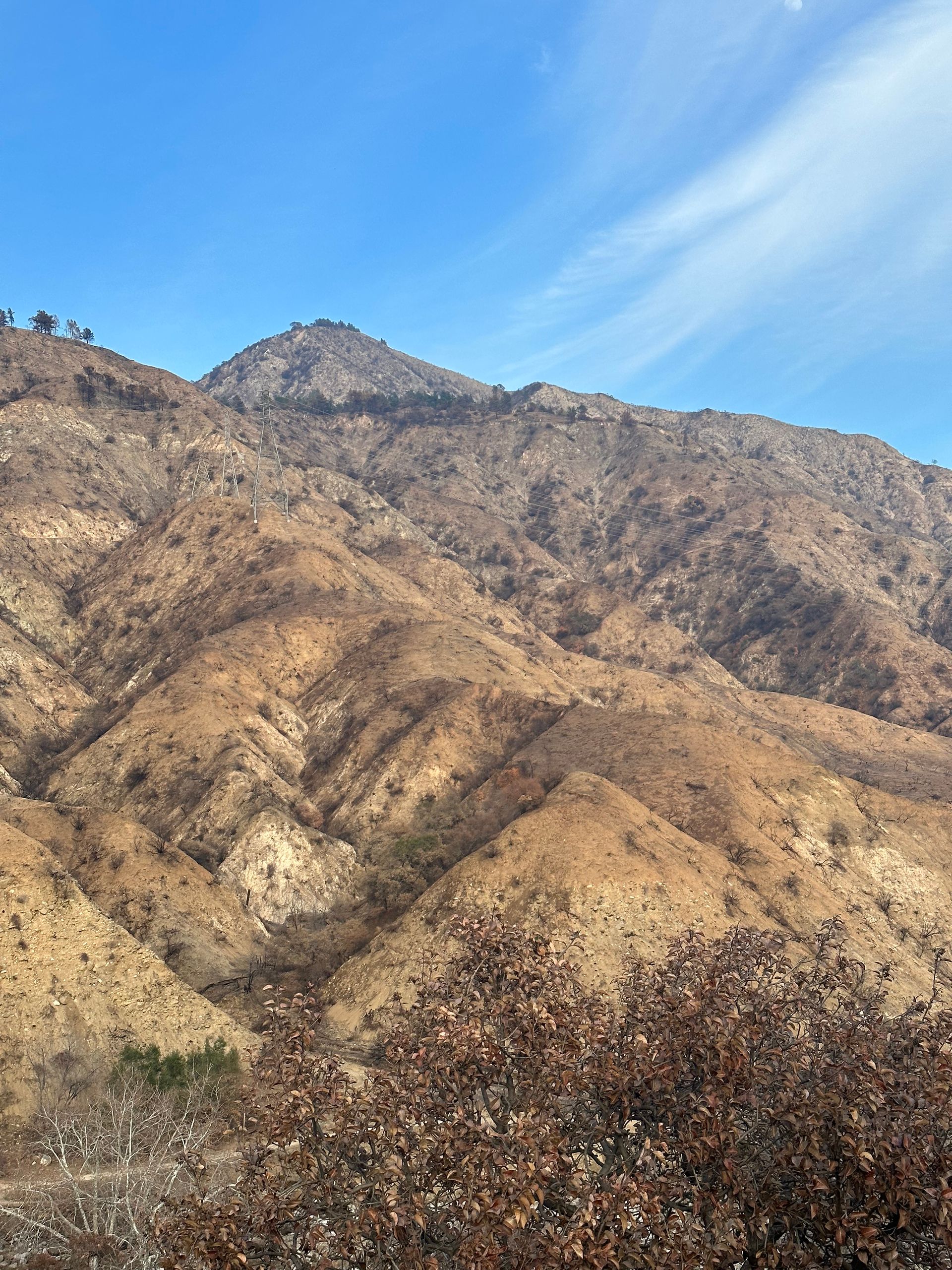
“Now all I see is a tinderbox”: Eaton Canyon at the base of the San Gabriel Mountains, where the Eaton fire began
The Eaton and Palisades fires, which destroyed more than 11,000 houses in all, therefore struck directly at the city’s sense of self, as surely as the Sept. 11 attacks, by targeting Manhattan’s financial district, wounded a core part of New York’s identity. More than 95% of the L.A. fire losses, by dollar value, came from single-family houses, according to one estimate.
And the houses that edged up into the foothills that ring Los Angeles, territory known as the Wildland-Urban Interface, or WUI? These may be the most quintessentially L.A. houses of all, their SoCal bona fides inextricable from their interest in staking out a place on the regional fringe. For all their demographic and other differences, Altadena and the Palisades have this in common.
It’s worth expanding briefly on this point, as I think it’s still poorly understood by those outside Southern California. If L.A. is polycentric and diffuse—a city of enclaves—these two fire-wracked communities are alike in embodying this arrangement to an extreme degree. They bracket downtown Los Angeles as places full of people who came to L.A. to get away from something as much as find something, and who then discovered they wanted to get away from L.A. as well. (In the case of many Black homeowners in Altadena, denied mortgages in other parts of L.A. County in the middle decades of the twentieth century, this was sometimes by necessity.) The British writer L.P. Jacks once called Los Angeles, perched at the edge of the continent, continually remade by waves of newcomers, the ideal place “to study America in flight from herself.” Altadena and the Palisades have represented this same idea within the geography of L.A., at neighborhood scale, on the edge of the edge.
It would be tempting, as a result, to chalk up the severely disjointed nature of the rebuilding effort so far, as we near the fires’ first anniversary, to some kind of psychic shock at the level of civic identity. If there was any galvanizing, countywide sense of solidarity right after the disaster, and most Angelenos would tell you there wasn’t much, it has long since dissipated. As the L.A. architect Michael Maltzan told me a few months ago, “the adrenaline has worn off.”
There is also the matter of jurisdictional overlap in Los Angeles, a city the urban historian Robert M. Fogelson aptly labeled “the fragmented metropolis” in 1967. (If that metaphor’s not quite to your liking, might I recommend “The Reluctant Metropolis,” William Fulton’s book on L.A. from 1997?) The power of every Los Angeles mayor is hamstrung by the city charter, while the footprint of L.A. County—which has a population just shy of 10 million, or more than forty U.S. states—is vaster than even some locals realize.
Rebuilding on both sides of Los Angeles has picked up a bit of speed in recent weeks, with the L.A. Times reporting that the city (for the Palisades fire) and the county (for Eaton) had by mid-December issued building permits for roughly fifteen percent of the sites where houses were destroyed. That’s a middling rate compared to other California communities ravaged by wildfire in recent years. Meanwhile businesses in Altadena, like the small café I saw in ruins while driving with Jonathan Veitch, are working to rebuild. Still, the overarching sentiment among residents and experts on L.A. politics I’ve spoken to is that the response to the fires has been marked by dysfunction and a lack of coordination among city, county, and state officials.
Yet the chaos of the rebuilding is not simply a product of L.A.’s fractured governance. The confusion fire victims have sensed this year in the official response is emblematic of a broader crisis for American cities. It reflects the increasingly shriveled, defensive nature of American city-making in an era of climate risk, stark polarization, and sinking faith in public institutions.
Let us pause, then, to count the ways that U.S. cities find themselves under the gun.
One: The Trump administration is openly hostile to the bluest (read: biggest) metropolitan areas in the country, which means that muscular federal assistance to help rebuild after this disaster or adequately prepare for the next one, wherever it hits, has not been and will not be forthcoming. Meanwhile tariffs on construction materials like lumber continue to make rebuilding more expensive and fraught with uncertainty.
Two: Democratic leadership in those cities has been increasingly at war with itself in recent years, riven by scandal, corruption charges, or deep philosophical fissures—or, in the case of New York under Eric Adams and Los Angeles under my former boss Eric Garcetti and now Mayor Karen Bass, by all three.
Three: Climate risk hangs over a growing number of American cities like the sword of Damocles.
Four: Insurance companies, who understand that risk most fully and precisely of all, are tightening the screws on homeowners, builders, and city leaders alike, suggesting that real-estate development will increasingly follow an actuarial logic as much as a policy-driven or community-minded one.
In other words, those of us watching from afar as fire-recovery efforts inch forward would be wise not to feel too superior. L.A.’s predicament, to a large degree, is one the rest of us find ourselves in as well.
This, at least, is a role Los Angeles is used to playing. In its relationship to other American cities—and to American urbanism more broadly—it has long been both the unique and emblematic example, the case study and the cautionary tale, the outlier and the precursor.
The rest of the country looks to L.A. to see what it doesn’t want to become, only to realize it already has.

Pacific Palisades
More than we have properly acknowledged, American cities managed the risk of natural disaster remarkably well over the last century or so. This was certainly true of fire danger in Los Angeles, despite more than a century of literary, artistic, and cinematic depictions of the city in flames. Expert fire crews almost always were able to corral wildfires from on the ground or in the air, in extreme cases shepherding them all the way to the beach before they burned themselves out in the Pacific Ocean. Meanwhile urban fires, especially tenement fires in and around downtown Los Angeles, were more often fatal, as Mike Davis, the late writer who served as the region’s resident Cassandra, began pointing out more than 30 years ago.
Something similar is true of the other kinds of risk for which Los Angeles is notorious, especially earthquakes and floods. For a long time—and this fact has been missing from much of the fire coverage I’ve seen this year—deciding to live, build, and invest even on the extreme edges of Los Angeles made unimpeachable logical sense.
Far more people were killed in car accidents in Iowa last year (357) than have died in L.A. natural disasters, including earthquakes and wildfires, since World War II (fewer than 200). And yet there is no literary canon of vehicular threat for Iowa, no Hawkeye State Joan Didion writing of the “prickly dread” that accompanies getting behind the wheel. Southern California, with its strict building codes, cutting-edge water conservation strategies, and supremely effective firefighting techniques, had figured out how to make it all work. Perhaps precariously so, but undeniably.
More than anything else, what my repeated visits to Los Angeles this year made clear is that this careful balance is now wrecked, perhaps for good. According to Frank Frievalt, a retired fire chief who directs the Wildland-Urban Interface FIRE Institute at Cal Poly San Luis Obispo, it would be a mistake to think of the Palisades and Eaton fires, which killed 30 people, as in any way anomalous. Cities like Los Angeles find themselves, Frievalt said, “at the leading edge of a perfect storm” created by climate change, the buildup of combustible vegetation, and the expansion of homebuilding into the WUI. And even as firefighting techniques continue to gain sophistication, combating a WUI fire, especially in a period of high winds, is a different challenge altogether.
“According to the U.S. Forest Service, 98 percent of wildfires are suppressed at 100 acres or less,” Frievalt told me. “That is absolutely crushing it. We are totally winning the wildfire game. But we are totally losing the wildland-urban interface conflagration game.”
He points to recent research suggesting that we are at the start of a fifty-year period, ushered in by climate change, in which the average number of acres burned each year by fires that begin in the WUI and spread into more densely populated areas—the very path followed by the L.A. fires—is likely to be two-and-a-half to three times higher than the worst annual losses recorded in any year to date.
“What we’re about to see is orders of magnitude beyond anything we’ve experienced. These WUI communities have the fuel, weather, and topography that’s conducive to fire spread. When you add a prevailing strong, dry wind following a period of drought,” which can then deliver embers deep into densely populated areas, “any place can burn down.”
The best-case scenario, Frievalt and others told me, is that the approach to managing risks accelerated by climate change, especially wildfire and flooding, undergoes something like the transformation that reshaped auto safety in the 1970s and earthquake preparedness two decades later. In those instances insurance companies either banded together with willing government bodies to develop stringent and far-reaching new regulations or—if those bodies weren’t so willing—heavily lobbied them to pass new laws.

Along the Pacific Coast Highway in Malibu
Elected officials in Los Angeles have stressed above all the need for hardening existing and new houses against fire. But engaging with the larger land-use questions at play—to say nothing of organizing some kind of managed retreat from the WUI, with rules prohibiting new construction in the most fire-prone areas—has been a non-starter. Instead fire victims, as was the case with flood victims displaced by Hurricane Katrina, understandably are given the moral high ground if they choose, and have the means, to rebuild. In the aggregate this tends to reinforce the very development patterns that have proved so vulnerable to disaster.
The last several months have been sobering for many of the L.A. fire victims, as they begin to get a full sense of the depths of the insurance and regulatory purgatory they find themselves in. Even as they continue to take stock of the many policy and operational failures that paved the way for the disaster or made it worse—outdated fire hydrants in hillside neighborhoods, reservoirs drained or taken offline, emergency alerts that went to some parts of Altadena and not to others—they’ve realized by now that any hope of a truly coordinated rebuilding plan is an illusory one.
Lisa Dawe, who lost the Altadena house she shared with her husband and son to the Eaton fire, told me in the weeks after the disaster that they were determined to rebuild. But even the first steps of that daunting process were tangled in bureaucracy. Fire victims were required to fill out a form if they wanted to opt out of a lot-clearance program overseen by the Army Corps of Engineers. Dawe said public agencies repeatedly misplaced their form, requiring them to complete it four times.
“It’s just those micro moments where you’re like, ‘We’re screwed,’” she said, echoing complaints I heard from a number of homeowners in the two fire zones. “If you can’t get the little things right, how do you do the bigger things?”
Dana Cuff, a professor of architecture at UCLA, with whom I’ve collaborated on a number of projects over the years, told me that she had been invited to join five separate blue-ribbon commissions on fire recovery, including panels organized by city, county, and state leaders. She saw little indication that the groups would collaborate in any meaningful way.
“What has characterized the recovery process is a super-fragmented response,” Cuff said. “Everyone’s trying to organize and contribute—or protect their interests—in some way, and there’s no leadership to stand up and bring that together.”
Meanwhile, the gap between the fire-risk messaging coming from public agencies, on the one hand, and the insurance industry on the other widened this year, difficult as that may be to believe. In March, for the first time in more than a decade, the California Department of Forestry and Fire Protection, known as Cal Fire, released new fire-danger maps for Los Angeles County. At first glance, the updated maps seemed highly responsive to new climate-change-driven risk, adding more than 3.5 million acres to zones with at least some degree of wildfire hazard.
But the fine print told a more discouraging story about the possibility that recent disaster might be a catalyst to reorder the city’s priorities the way, for instance, that the 1871 fire remade Chicago. On closer inspection the new state maps revealed themselves to be far more sanguine about fire risk than another recent assessment of L.A. County neighborhoods, this one by a company called First Street, which provides data to insurance companies and banks as well as public agencies.
First Street identified 94% percent of properties within the Eaton fire zone, for example, as having severe or extreme wildfire risk. The Cal Fire maps, according to data analysis by the L.A. Times, put just 21% of those properties in the “very high” risk category.
What the state maps are saying is that the Eaton fire was an outlier, a freakish disaster unlikely to be repeated. The First Street maps see it as a harbinger.
In the absence of a forthright effort from public bodies in Southern California to confront the new face of climate risk, the course of recovery is being shaped most directly by individual homeowners, or small groups of neighbors deciding to rebuild in tandem, with their ability to return largely dependent on how much insurance they were carrying.
If recent recovery efforts from fire in other parts of California are any indication, that means wealthier neighborhood will see residents returning at a far quicker clip. These homeowners are better connected politically and can hire attorneys, architects, and other advisors—a whole battalion of experts and fixers to cut through the inevitable bureaucracy and red tape that attends post-disaster planning.
In the relatively well-to-do Sonoma County communities destroyed by the 2017 Tubbs fire, more than 80 percent of affected families had moved back in within three years. In Paradise, the working-class town in the Sierra foothills devastated by the 2018 Camp fire, the percentage after five years was less than 35 percent. Anyone who knows Los Angeles will understand what figures like those portend for Pacific Palisades (median household income $180,152) and Altadena ($52,748).
In Malibu, meanwhile, many of the hundreds of beach houses destroyed by the Palisades fire occupied a thin strip of land between the Pacific Coast Highway and the Pacific Ocean. Those houses had been playing a high-stakes game of chicken with climate risk, threatened on their inland flank by increasingly aggressive wildfire and on the ocean side by sea level rise. It was fire, in the end, that got them.
Whatever rises to replace them will start that game all over again. And it will be increasingly tough to think of their double vulnerability, as we did in Southern California for so long, as somehow exotic.
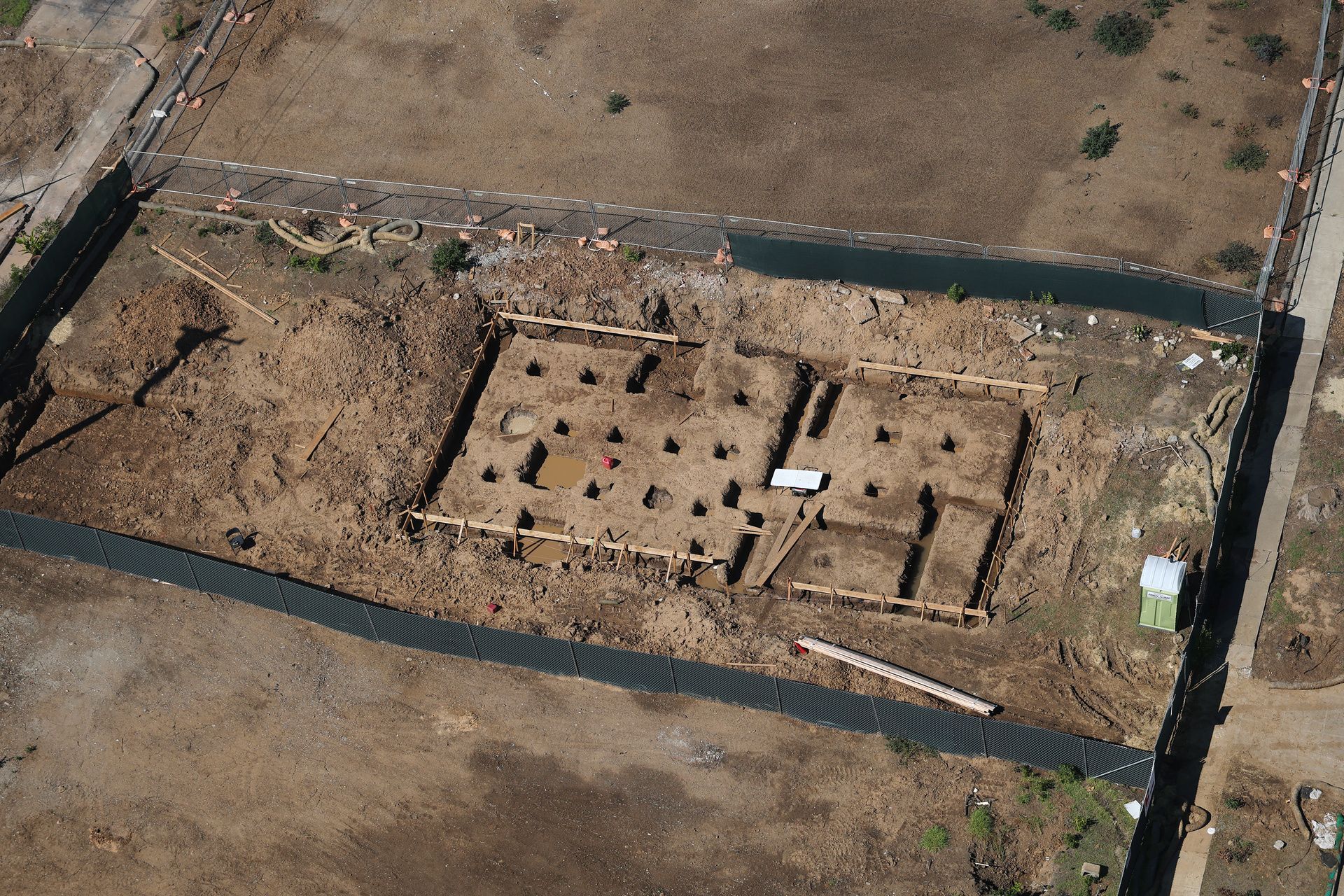
A house being rebuilt in Pacific Palisades, October 2025. Credit: mpi34/MediaPunch/IPX, licensed via AP
And so Los Angeles finds itself playing the role of bellwether once again, this time heralding the arrival of climate-change perma-risk and what we might think of as go-it-alone, left-to-our-own-devices urbanism. If you have the means—if your insurance was sufficient, or you can finance new construction on your own—rebuilding after a fire or another climate-fueled disaster will be possible. If you don’t, it won’t, and you may find yourself listening to a pitch from an institutional investor or other prospective buyer and simply get out of Dodge. Some admirable efforts to protect Altadena from rampant speculation have already emerged, but they have yet to be backed or expanded by effective county-wide policy changes.
In those rare instances when a city or metropolitan region has advanced a truly forward-looking plan to address climate change and other gathering challenges—think of the recent introduction of congestion pricing in Manhattan—the larger system of governance seems to rebel against itself, as if it were sending antibodies to attack a virus. Even before the Trump administration took aim at congestion pricing in New York, this scenario had already unleashed itself, with the state of New Jersey, the United Federation of Teachers, and the Staten Island borough president, Vito J. Fossella, suing to block it. Somehow the plan managed to finish 2025 not only intact but as a major governance success story, ushering in declines in traffic, pollution, and noise complaints while raising more than $500 million for the Metropolitan Transportation Authority, higher than initial estimates.
Or consider Miami, where a population boom in recent years flies in the face of predictions that sea level rise will leave as much as 60 percent of Miami-Dade County underwater by 2060. City planners can hardly keep up with the demand for construction permits while, at the same time, releasing dire white papers detailing worsening flood risks driven by climate change. The left hand of official policy beckons; the right holds up a cautionary palm.
Increasingly, moreover, climate risk has the ability to follow us nearly anywhere. My family and I left Southern California in the fall of 2022, after 18 years. We moved primarily because my wife and I both took jobs at Yale. But I’d be lying if I said we didn’t discuss wildfire risk as we were packing up. Connecticut—green, leafy Connecticut, damp in winter and humid in summer—seemed a safe bet. Our new home, New Haven, gets significantly more rain each year than Seattle.
Yet it wasn’t long before that risk caught up with us on the far side of the continent. In the fall of 2024, after a particularly warm and dry stretch in the Northeast, more than 800 brush fires broke out across New York, New Jersey, and Connecticut. One afternoon in early November, I climbed out of a subway station in Brooklyn and was hit with an unnervingly familiar smell—what I have long thought of as a Los Angeles smell. A wooded section of Prospect Park was on fire.
Punch List is published weekly. Subscribe free here, or sign up for a paid subscription, with bonus material, here.
Email: [email protected]
Reply